

Female Hair Transplant in Marmaris – Complete Guide for Women
Hair loss is often associated with men, but thinning hair, a widening part, a high hairline and localised hair loss can also have a significant impact on women. For suitable candidates, a female hair transplant in Marmaris can provide a long-term approach to restoring hair in carefully selected areas using the patient’s own donor follicles.
However, hair transplantation for women requires particularly careful assessment. Female hair loss can have several causes, and surgery is not appropriate for every type of thinning. Before discussing the number of grafts or choosing between FUE and DHI hair transplant techniques, the first priority should be understanding the pattern of hair loss, the quality of the donor area and whether transplantation is likely to provide a worthwhile cosmetic improvement.
For international patients, Marmaris also offers the possibility of combining treatment with a stay on Turkey’s Aegean coast. This guide explains how female hair transplantation in Marmaris works, who may be suitable, hairline lowering, unshaven options, recovery, expected growth and what women travelling from the UK and Europe should consider before treatment.
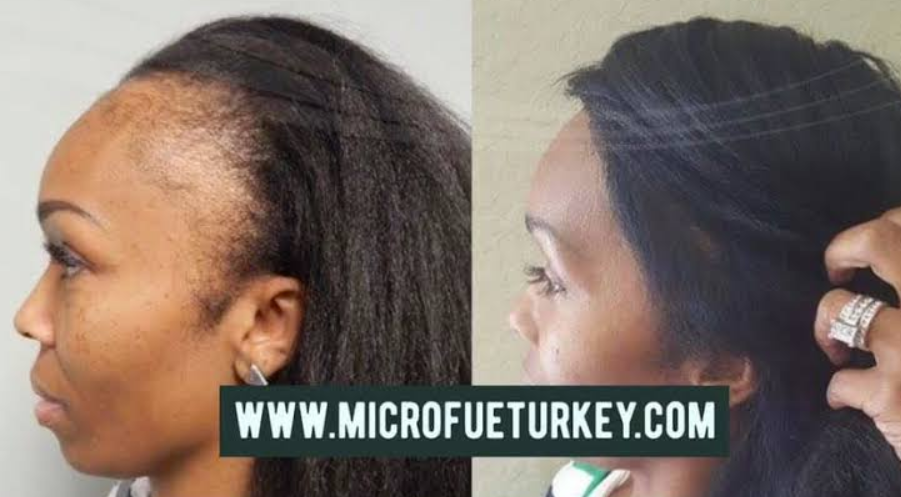
What Is a Female Hair Transplant?
A female hair transplant involves moving suitable hair follicles from a donor area, usually at the back or sides of the scalp, to areas where greater density or hairline coverage is required.
The fundamental principle is similar to male hair transplantation, but the treatment plan can be very different.
Women commonly seek treatment for concerns such as:
- A naturally high forehead
- Receding temples
- A widening central part
- Localised thinning
- Traction-related hair loss
- Scarring with reduced hair growth
- Hairline irregularities
- Previous surgery affecting the hairline
- Selected cases of female pattern hair loss
The objective is not simply to implant as many grafts as possible.
A successful plan needs to consider the existing hair, future progression of thinning, donor capacity, direction of growth and the aesthetic proportions of the female hairline.
Is Hair Transplantation Suitable for Women?
Some women can be very good candidates for hair transplantation, while others may benefit more from medical investigation or non-surgical treatment.
This distinction is particularly important because female hair loss is not always concentrated in a predictable pattern.
A woman with a stable high hairline and strong donor area presents a very different situation from someone experiencing diffuse thinning throughout both the recipient and donor regions.
Potential candidates may include women with a naturally high hairline, stable temple recession, selected traction alopecia patterns, localised scars or stable areas of permanent hair loss.
Women experiencing active or unexplained diffuse shedding should normally have the cause investigated before considering surgery.
Why Is Female Hair Loss Different?
Female hair loss can be complex.
Hormonal factors, genetics, nutritional deficiencies, stress, medications, thyroid conditions, iron deficiency and various forms of alopecia may contribute to thinning or shedding.
This is why a photograph alone cannot always establish whether a woman is suitable for surgery.
Photos are useful for an initial assessment, but medical history and, when appropriate, further clinical investigation can be important.
Hair transplantation relocates follicles. It does not treat every underlying cause of ongoing hair loss.
If surrounding natural hair continues to thin after transplantation, the overall appearance can change over time. Long-term planning is therefore essential.
Female Hairline Lowering in Marmaris
One of the clearest indications for female hair transplantation is a naturally high hairline or large-looking forehead.
In appropriate candidates, follicles can be transplanted in front of the existing hairline to create a lower and more balanced frame around the face.
This procedure is sometimes searched for as:
female hairline lowering,
forehead reduction hair transplant, or
female hairline transplant.
The design stage is especially important.
A female hairline should not simply be drawn as a straight line across the forehead. Facial proportions, temple points, forehead shape, age and existing hair growth all need to be considered.
Small irregularities and careful graft placement can help avoid an artificial appearance.
Female Temple Hair Transplant
Temple recession can make the forehead appear wider and may change the overall shape of the face.
A female temple hair transplant in Marmaris may be considered when hair loss in this region is stable and the donor area is suitable.
Temple work is technically demanding because the hairs naturally grow at very acute angles.
The direction and angle of implantation are therefore just as important as the number of grafts used.
Placing too many follicles or using inappropriate angles can produce an unnatural appearance.
Hair Transplant for a Widening Part
A widening central part is a common concern among women with thinning hair.
Hair transplantation may be considered in selected cases, but this requires careful evaluation because the recipient area may still contain significant numbers of existing hairs.
The medical team needs to determine whether transplantation can be performed without unnecessarily compromising existing follicles and whether the surrounding hair is sufficiently stable.
Diffuse thinning across the entire scalp may make transplantation less appropriate, particularly when the donor region is also affected.
This is why “I have thin hair” is not enough information to determine candidacy.
The pattern matters.
Female Pattern Hair Loss and Hair Transplantation
Female pattern hair loss can present as reduced density over the central or upper scalp while the frontal hairline may remain relatively preserved.
Hair transplantation may help selected women, but surgery is not automatically the first or most appropriate option.
The stability of hair loss, donor density and extent of miniaturisation need to be evaluated.
If there is significant ongoing loss, a clinician may recommend investigating or managing the underlying condition before surgical restoration is considered.
The aim should always be a sustainable long-term plan rather than simply increasing density in one area today.
Hair Transplant for Traction Alopecia
Traction alopecia can occur after repeated tension on the hair from tight hairstyles, braids, extensions or similar practices.
In early stages, reducing the source of tension may allow improvement.
However, long-standing traction can sometimes permanently damage follicles.
When hair loss is stable and scarring has occurred, hair transplantation may be an option for selected patients.
The affected scalp needs to be assessed carefully before surgery because transplantation into scarred tissue may behave differently from transplantation into unaffected scalp.
FUE Hair Transplant for Women in Marmaris
FUE, or Follicular Unit Extraction, is commonly used in modern hair restoration.
During FUE, individual follicular units are extracted from the donor region and prepared for transplantation.
Recipient sites are then planned according to the desired density, direction and aesthetic design.
For women, one of the main concerns is often shaving.
Traditional FUE may involve shaving part or all of the donor area, depending on the treatment plan. However, selected patients may have alternatives that reduce the amount of visible shaving.
The appropriate approach depends on graft requirements, hairstyle, donor characteristics and the technique used by the medical team.
DHI Hair Transplant for Women
DHI, or Direct Hair Implantation, generally refers to implantation using specialised implanter pens.
The extracted follicles are loaded into the implanter and placed into the recipient area according to the planned angle, direction and distribution.
DHI is often marketed as universally superior to FUE, but that is an oversimplification.
FUE primarily describes how follicles are extracted, while DHI usually describes an implantation approach. They are therefore not always direct opposites.
For female patients, DHI may be useful in selected situations, particularly when working between existing hairs, but suitability depends on the individual case.
The best technique is the one appropriate for the patient’s anatomy and treatment goals.
Can Women Have a Hair Transplant Without Shaving?
This is one of the most common questions from female patients.
In selected cases, a no-shave or partially unshaven female hair transplant may be possible.
Instead of shaving the entire scalp, the donor hair may sometimes be prepared in a way that allows surrounding longer hair to conceal the extraction area.
This can make the early recovery period more discreet.
However, unshaven transplantation is not appropriate for everyone.
Large graft requirements may make extensive no-shave procedures less practical, and the final recommendation should depend on donor characteristics and the planned recipient area.
Women should therefore avoid choosing a technique solely because it promises “no shaving.”
The quality of the surgical plan remains more important.
How Many Grafts Do Women Need?
There is no standard graft number for a female hair transplant.
A small temple correction may require considerably fewer grafts than treatment of a high hairline or larger area of thinning.
The graft estimate depends on:
- Size of the treatment area
- Existing hair density
- Donor density
- Hair calibre
- Hair colour and scalp contrast
- Desired hairline position
- Pattern of thinning
- Future hair-loss risk
A personalised assessment is therefore necessary.
More grafts do not automatically mean a better result. Protecting the donor area and distributing grafts intelligently can be more important than achieving the largest possible number.
The Importance of the Female Donor Area
The donor area is the foundation of any hair transplant.
Before surgery, the medical team should assess donor density, hair calibre, scalp condition and whether thinning extends into the proposed donor zone.
This is particularly important for women with diffuse hair loss.
If the donor area itself is significantly miniaturised, extracting follicles may not provide a reliable long-term solution.
A responsible consultation should therefore evaluate both the area the patient wants treated and the area from which the follicles will be obtained.

Designing a Natural Female Hairline
Hairline design is one of the most artistic aspects of female hair transplantation.
The lowest possible hairline is not necessarily the most attractive or sustainable.
The design should complement the forehead, temples, facial proportions and available donor supply.
Fine single-hair grafts are generally particularly valuable around the leading edge because naturally occurring frontal hairlines are softer than the density behind them.
Direction is equally important.
Hair growing vertically or at inconsistent angles can look unnatural even if graft survival is good.
For this reason, design and implantation planning should be treated as central parts of the procedure rather than minor details.
What Happens on the Day of the Procedure?
The exact process depends on the selected technique and individual treatment plan.
Typically, the hairline or recipient areas are reviewed and marked before the procedure. The donor region is prepared, and local anaesthesia is used for the surgical areas.
Follicular units are then extracted from the donor region.
After preparation, the grafts are implanted into the planned recipient areas using the technique selected for the patient.
Hair transplantation can take several hours, particularly when larger numbers of grafts are required.
Patients should receive specific instructions regarding medications, food, alcohol, smoking, hair washing and other preparation before treatment.
Recovery After a Female Hair Transplant
The first days after transplantation require care.
Mild swelling, redness, tenderness and small crusts around transplanted grafts can occur during the early recovery period.
Patients receive instructions explaining how to protect and wash the transplanted area.
The grafts should not be scratched or rubbed.
The donor area also needs time to recover.
Women undergoing partially unshaven procedures may find that longer surrounding hair helps conceal the donor region during this stage.
Recovery varies between patients, so postoperative instructions from the treating medical team should take priority over generic online timelines.
When Can You Wash Your Hair?
Hair washing usually begins according to the clinic’s postoperative protocol.
The first washes are gentle because the newly implanted area should not be aggressively rubbed or exposed to strong water pressure.
As healing progresses, washing can gradually return towards normal.
Patients should use the products and technique recommended by their treatment team rather than experimenting with multiple cosmetic products immediately after surgery.
Shock Loss After Female Hair Transplant
Some transplanted hairs commonly shed during the early weeks after surgery.
This does not necessarily mean that the follicles have been lost.
New growth occurs later as follicles progress through their natural growth cycle.
Temporary shedding can also affect some existing hairs around the treatment area.
Because women undergoing density procedures may already have fine existing hair, this possibility should be discussed during consultation.
Female Hair Transplant Growth Timeline
Hair transplantation is not an instant-density treatment.
The appearance changes gradually.
During the early weeks, transplanted hairs may shed. Initial new growth commonly becomes noticeable over the following months, but early hairs may initially appear fine.
Density and hair calibre generally continue developing over subsequent months.
Many patients assess the more mature appearance around the 12-month stage, although some areas can continue changing beyond this point.
Individual timelines vary, and no clinic should guarantee identical growth rates or density for every patient.
Can You Swim After a Hair Transplant in Marmaris?
Marmaris is famous for its sea, beaches, swimming pools and yacht holidays, which makes this an important question.
A hair transplant should not be scheduled with the assumption that you can immediately return to swimming.
The recipient and donor areas need time to heal.
Sea water, swimming pools, direct sun exposure and physical activities can all be restricted during recovery.
Follow the specific postoperative instructions provided by your medical team.
If swimming and beach activities are an important part of your Marmaris holiday, it may be more practical to enjoy them before the procedure rather than immediately afterwards.
Can You Combine a Female Hair Transplant With a Marmaris Holiday?
Yes, with sensible planning.
Marmaris provides an attractive setting for international patients who want to combine treatment with time on Turkey’s Aegean coast.
However, the holiday should be planned around the medical procedure rather than the procedure being squeezed into a packed holiday itinerary.
Before surgery, you may be able to enjoy Marmaris, İçmeler, Turunç and surrounding areas normally.
After transplantation, the priority changes to recovery.
Swimming, sunbathing, strenuous exercise and certain activities may need to be temporarily avoided.
For many visitors, arranging the transplant towards the later part of the holiday can therefore be practical, provided sufficient time remains for the required postoperative checks.
Travelling From the UK to Marmaris for a Female Hair Transplant
Marmaris is particularly convenient for patients travelling from the UK during the main tourism season because of flight connections to Dalaman Airport.
International patients should consider the complete treatment journey rather than the operation alone.
Before booking flights, confirm:
- Preliminary suitability
- Planned treatment date
- Recommended length of stay
- Whether shaving is required
- Estimated graft requirement
- Technique being considered
- Postoperative check schedule
- When the medical team considers you fit to fly
Do not book an extremely tight return schedule before confirming the treatment plan.
Female Hair Transplant Consultation in Marmaris
An initial remote consultation can usually begin with clear photographs.
Useful photographs normally include the front hairline, both temples, top of the scalp, crown and donor area at the back and sides.
Women should also provide relevant information about the duration and progression of hair loss, medications, previous surgery, medical history and any known diagnosis related to hair loss.
Photos can help determine whether an in-person assessment is worthwhile, but they cannot replace every aspect of clinical examination.
For unexplained female hair loss, further medical evaluation may be appropriate before transplantation.
Female Hair Transplant in Marmaris: Is It Right for You?
A female hair transplant in Marmaris can be an option for women seeking treatment for a high hairline, temple recession, selected areas of thinning, traction-related hair loss or other stable patterns of permanent hair loss.
But female hair transplantation should never begin with the question:
“How many grafts can you implant?”
The more important questions are:
Why is the hair being lost? Is the loss stable? Is the donor area strong enough? Which areas will benefit from transplantation? How should the hairline be designed? And what will happen if the existing hair continues thinning in the future?
Once these questions have been answered, the medical team can determine whether FUE, DHI, partially unshaven transplantation or another approach is appropriate.
For international patients considering a female hair transplant in Marmaris, Turkey, the combination of professional treatment planning and a comfortable stay on the Aegean coast can make Marmaris an attractive destination.
The key is individual assessment.
A natural-looking female hair transplant is not created simply by implanting a large number of grafts. It depends on careful diagnosis, responsible donor management, appropriate hairline design, correct angles and distribution, and realistic long-term planning.
Women considering treatment should begin with a detailed consultation and clear photographs of both the thinning areas and donor region. From there, a personalised treatment plan can be created based on the individual pattern of hair loss, donor capacity and aesthetic goals.