

Can You Have a Hair Transplant With a Weak Donor Area?
A strong donor area is one of the most important factors in successful hair transplant planning. But what happens if the hair at the back and sides of your scalp is thin, your donor density is below average, or you have already had a previous hair transplant that used a significant number of grafts?
One of the most common questions from patients considering a hair transplant in Marmaris is: Can you have a hair transplant with a weak donor area?
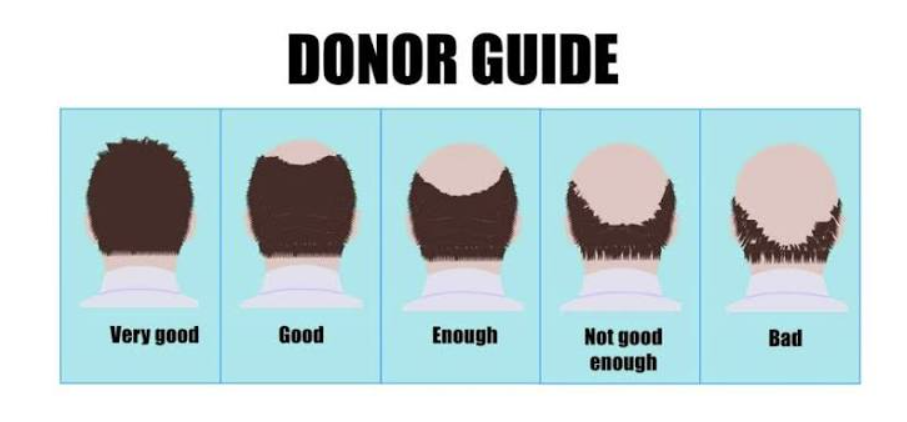
The answer is not simply yes or no.
Some patients with a limited donor area may still be suitable for hair transplantation, but the treatment plan usually needs to be more conservative. The number of grafts that can be safely extracted may be lower, the recipient area may need to be prioritised, and alternative donor sources such as beard hair may sometimes be considered.
Other patients may have donor characteristics that make further transplantation unsuitable.
The key is to understand that a hair transplant does not create new hair. It redistributes a limited supply of existing follicles. For this reason, responsible donor management is fundamental to achieving a natural-looking and sustainable result.
This complete guide explains weak donor areas, donor density, safe graft extraction, FUE and DHI, beard and body hair transplantation, second hair transplants and realistic expectations for patients with limited donor capacity.
What Is the Donor Area in a Hair Transplant?
The donor area is the region from which follicles are extracted for transplantation.
For most patients, the primary scalp donor zone is located around the back and sides of the head.
During an FUE hair transplant, suitable follicular units are individually extracted from this area and subsequently transplanted into areas affected by hair loss.
The donor region is important because its available follicles are finite.
Once an individual follicular unit has been extracted, another follicle does not simply grow in the exact extraction site to replace it.
This means the medical team must carefully distribute extractions across the donor region rather than taking too many grafts from a small area.
Good hair transplant planning therefore involves two objectives:
creating improvement in the recipient area while also preserving an acceptable appearance in the donor area.
What Does a Weak Donor Area Mean?
A weak donor area generally refers to a donor region with limited capacity for safe follicular extraction.
There is no single characteristic that defines every weak donor area.
A patient may have:
- Low follicular density
- Fine hair calibre
- Significant miniaturisation
- Diffuse thinning extending into the donor region
- A relatively small stable donor zone
- Previous FUE extraction
- Previous FUT surgery
- Scarring
- Uneven donor density
- Age-related changes in donor quality
Hair colour, curl, calibre and the contrast between the scalp and hair can also influence the visual coverage obtained from a particular number of grafts.
For example, two patients could receive the same number of grafts but achieve noticeably different visual density because their hair characteristics are different.
This is why graft numbers alone do not tell the whole story.
Can You Have a Hair Transplant With a Weak Donor Area?
Potentially, yes.
Having a weak donor area does not automatically mean that a hair transplant is impossible.
However, it usually means the treatment needs more careful planning.
A patient with excellent donor density may have enough follicles to address the frontal hairline, mid-scalp and potentially the crown over one or more procedures.
Someone with limited donor capacity may need to prioritise.
For example, the medical team may recommend concentrating available grafts in the frontal third rather than spreading a small number of follicles across a very large bald area.
This can sometimes create greater visual improvement because the frontal hairline has a major influence on how hair loss is perceived from the front.
However, every case is different.
The appropriate strategy depends on the pattern of hair loss, donor characteristics, age, existing hair and long-term risk of further loss.
Why Is Donor Area Assessment So Important?
The donor area should ideally be assessed before promising a specific graft number.
Simply looking at the bald area and deciding that it requires 4,000 or 5,000 grafts is not enough.
The more important question is:
Can the donor area safely provide that number of suitable grafts?
During donor assessment, clinicians may consider factors such as density, follicular distribution, hair calibre, miniaturisation and previous extraction patterns.
The objective is not to extract the maximum possible number of grafts on the day.
It is to determine an appropriate number while preserving donor appearance and considering possible future hair loss.
What Is Donor Density?
Donor density refers to the concentration of hair or follicular units within the donor region.
Higher density can potentially provide greater flexibility for extraction, while lower density may restrict the number of follicles that can be removed without making the area look visibly thin.
But density is only one factor.
Hair calibre matters as well.
Thicker hairs can provide greater visual coverage than very fine hairs. Curly or wavy hair can also create different coverage characteristics compared with straight hair.
The number of hairs contained within follicular units also matters.
For this reason, a proper donor assessment should involve more than simply estimating how many hairs are visible at the back of the head.
How Many Grafts Can Be Taken From a Weak Donor Area?
There is no universal safe number.
Statements such as “everyone can provide 4,000 grafts” or “6,000 grafts can always be extracted” should be treated cautiously.
The available number depends on the individual.
One patient may have sufficient donor characteristics for a larger extraction, while another may require a significantly more conservative approach.
The medical team also needs to consider whether the patient has already undergone transplantation.
If 3,000 or 4,000 grafts were previously extracted, the remaining donor capacity will not be the same as it was before the first procedure.
This becomes particularly important when planning a second hair transplant.
What Is Donor Overharvesting?
Donor overharvesting occurs when too many follicles are extracted or when extractions are poorly distributed.
This can leave the back or sides of the scalp looking:
- Patchy
- Moth-eaten
- Uneven
- Excessively thin
- Visibly scarred
Overharvesting can be difficult to correct because the donor supply has already been depleted.
This is one reason patients should not select a clinic based purely on which provider promises the highest graft number.
A responsible hair transplant plan needs to protect both sides of the procedure: the recipient area and the donor area.
Is 4,000 or 5,000 Grafts Better Than 2,500 Grafts?
Not necessarily.
A higher graft number can be useful when the patient has a large treatment area and sufficient donor capacity, but more is not automatically better.
Suppose a patient’s donor area can safely support a conservative procedure but a very large number of grafts is extracted simply to advertise a “maximum graft” session.
The recipient area may gain follicles, but the donor region could become visibly depleted.
Instead, a carefully planned 2,500-graft procedure concentrated in a strategically important area may sometimes produce a more balanced cosmetic improvement than spreading an unsafe or insufficient supply across the entire scalp.
The appropriate number should be determined by anatomy rather than marketing.
Can You Have FUE With a Weak Donor Area?
FUE hair transplantation may still be possible in selected patients with limited donor capacity.
However, extraction needs to be carefully distributed.
The surgeon and medical team must consider which follicles are suitable for harvesting and how many can be removed without creating unacceptable donor thinning.
Patients with very limited donor density may require fewer grafts than they initially hoped for.
This should be explained during consultation rather than discovered after surgery.
Is DHI Better for a Weak Donor Area?
DHI is sometimes promoted as being better for weak donor areas, but this can be misleading.
DHI generally refers to the method used to implant extracted follicles using an implanter device.
It does not magically increase the number of follicles available in the donor region.
If the donor area can safely provide only a limited number of grafts, changing the implantation method does not create additional donor hair.
DHI may be useful in selected recipient-area situations, but donor management remains essential regardless of implantation technique.
The choice between FUE-based approaches, DHI implantation and other techniques should therefore be made according to the individual treatment plan.
What If the Scalp Donor Area Is Not Strong Enough?
When scalp donor capacity is insufficient, several possibilities may need to be considered.
The first option is often simply to reduce the treatment area.
Instead of attempting to cover the frontal scalp, mid-scalp and crown simultaneously, the available grafts can potentially be concentrated where they will provide the greatest cosmetic value.
Another possibility in selected patients is the use of non-scalp donor hair, particularly beard follicles.
However, body donor hair has different characteristics and is not a universal substitute for scalp hair.
Can Beard Hair Be Used for a Hair Transplant?
Yes, beard hair can sometimes be used as an additional donor source in selected patients.
Beard follicles are usually thicker than many scalp hairs, which can make them useful for adding visual density in appropriate areas.
However, beard hair does not behave or look exactly like scalp hair.
For this reason, it is generally not the first choice for creating the delicate leading edge of a natural frontal hairline.
Fine scalp hairs are usually more appropriate in this region.
Beard grafts may instead be integrated with scalp grafts in selected areas where additional coverage is required.
The availability of beard grafts also varies significantly between patients.
A strong beard does not automatically mean thousands of follicles should be extracted.

Can Chest Hair Be Used for Hair Transplantation?
Chest and other body hair can sometimes be considered in specialised cases, particularly when scalp donor supply is severely limited.
However, body hair differs from scalp hair in growth cycle, calibre, length and texture.
Therefore, body hair transplantation should not be viewed as an unlimited replacement donor source.
It is usually considered an additional resource for carefully selected patients rather than a first-line alternative to scalp follicles.
The suitability of beard or chest donor hair needs to be evaluated individually.
Can Scalp, Beard and Chest Hair Be Combined?
In advanced hair-loss cases, a treatment plan may sometimes combine multiple donor sources.
For example, scalp follicles can be prioritised for areas where natural softness and hair characteristics are particularly important, while selected beard follicles may be used to support density farther behind the hairline.
Body hair may be considered in more specialised circumstances.
This approach requires careful planning because different donor hairs have different visual and growth characteristics.
The objective should be to blend them appropriately rather than simply maximise the graft count.
Weak Donor Area and Crown Hair Transplantation
The crown can be particularly challenging for patients with limited donor supply.
The crown may require a substantial number of grafts because of its surface area and natural spiral pattern.
For a patient with advanced hair loss and a weak donor area, attempting dense crown coverage can consume grafts that might otherwise be used to reconstruct the frontal region.
This leads to an important planning question:
Should the hairline or crown be treated first?
There is no universal answer, but donor capacity and cosmetic priorities need to be discussed carefully.
In some patients, frontal restoration may be prioritised while crown coverage remains lighter.
Weak Donor Area and Norwood 6 or 7 Hair Loss
Advanced hair loss creates one of the biggest challenges in transplantation.
Patients with extensive baldness may have a very large recipient area but only a limited donor supply.
The mathematical imbalance is straightforward: there may not be enough permanent donor follicles to recreate the density that existed before hair loss.
This does not automatically mean transplantation is impossible.
It means expectations need to be realistic.
Strategic placement, conservative hairline design and prioritisation of specific zones may create meaningful improvement, but achieving dense coverage across the entire scalp may not be feasible.
Can You Have a Second Hair Transplant With a Weak Donor Area?
Possibly.
A second hair transplant in Marmaris should begin with careful examination of what remains in the donor region.
The medical team needs to consider:
- How many grafts were previously extracted
- Where they were extracted
- Whether the donor looks depleted
- Existing FUE scars
- Remaining density
- Hair calibre
- Areas requiring additional transplantation
If the previous surgery was conservative and the donor remains strong, additional extraction may be possible.
If the donor was heavily harvested, the second procedure may need to be significantly smaller or alternative donor sources may need to be considered.
In some cases, another transplant may not be advisable.
Can an Overharvested Donor Area Be Repaired?
Repair options depend on the severity and pattern of depletion.
Some patients may benefit from strategic hair transplantation into visibly depleted areas, but this requires donor hair from somewhere else.
Other cosmetic approaches, including scalp micropigmentation in appropriate candidates, may sometimes be discussed.
The first objective should be preventing overharvesting in the first place.
Once donor follicles have been unnecessarily depleted, treatment options become more limited.
Does a Weak Donor Area Mean Poor Hair Transplant Results?
Not automatically.
A patient with limited donor supply can still potentially achieve a meaningful cosmetic improvement when expectations and treatment areas are appropriately managed.
For example, rebuilding a natural frontal hairline and adding density behind it can substantially change the appearance from the front even if complete crown coverage is not possible.
The problem occurs when the treatment plan promises a level of coverage that the donor area cannot realistically support.
Good planning means matching the patient’s goals to the biological resources available.
Can Medical Treatment Strengthen a Weak Donor Area?
This depends on why the donor appears weak.
If there is miniaturisation or another underlying hair-loss condition, a clinician may discuss whether medical evaluation or treatment is appropriate.
However, patients should be cautious about claims that a product can simply transform a genuinely low-density donor area into an unlimited source of transplant grafts.
Medical treatment and hair transplantation serve different purposes.
A proper diagnosis is particularly important when thinning extends into areas normally expected to function as permanent donor zones.
Who May Not Be Suitable for a Hair Transplant?
Hair transplantation may not be recommended when the donor supply is inadequate for the intended treatment, when hair loss is unstable, or when the donor region itself shows significant diffuse miniaturisation.
Certain scalp or medical conditions may also require investigation before surgery.
Age, pattern of loss and future progression also matter.
The correct decision is not always to operate.
Sometimes postponing surgery, reducing the treatment area or choosing a non-surgical strategy is more appropriate.
How Is a Weak Donor Area Assessed Before Treatment in Marmaris?
International patients considering a hair transplant in Marmaris, Turkey can usually begin with a preliminary photo assessment.
Clear photographs should include:
- Front hairline
- Left temple
- Right temple
- Top of scalp
- Crown
- Back donor area
- Left donor side
- Right donor side
Photographs should be taken in good natural light without hair fibres, concealers or heavy styling products.
Patients who have undergone a previous hair transplant should also provide the approximate date, technique and graft number if known.
This information helps the medical team understand both the recipient requirement and remaining donor capacity.
Final suitability should still be confirmed through appropriate clinical assessment.
Hair Transplant in Marmaris With a Limited Donor Area
Choosing treatment with a weak donor area requires a different mindset from simply asking for the maximum number of grafts.
The goal should be maximum cosmetic benefit from a safe and sustainable number of donor follicles.
For one patient, that may mean concentrating grafts around the frontal hairline.
For another, it may mean combining scalp and beard follicles.
For someone who has already undergone multiple procedures, the correct recommendation may be to avoid further aggressive extraction.
Marmaris can also be convenient for international patients who want to combine treatment with time on Turkey’s Aegean coast, but the holiday should be planned around postoperative requirements.
Swimming, strong sun exposure and strenuous activities may need to be temporarily restricted after transplantation.
Can You Have a Hair Transplant With a Weak Donor Area? Final Answer
Yes, some patients can have a hair transplant with a weak donor area, but not everyone with limited donor hair will be a suitable candidate.
The decision depends on the strength and stability of the donor region, the extent of hair loss, previous surgeries, hair characteristics and the patient’s expectations.
The most important principle is donor preservation.
A hair transplant should not sacrifice the appearance of the back and sides of the scalp simply to achieve a larger graft number.
For patients with limited scalp donor supply, a responsible treatment plan may involve fewer grafts, strategic frontal coverage, conservative hairline design or, in selected cases, additional beard or body donor hair.
Patients with advanced hair loss may also need to accept that complete high-density coverage of the hairline, mid-scalp and crown is not biologically achievable with their available donor supply.
Before planning a FUE or DHI hair transplant in Marmaris, send clear photographs of both the areas affected by hair loss and the entire donor region. If you have previously undergone hair transplantation, include information about your earlier procedure.
A careful donor assessment can then determine whether transplantation is appropriate, approximately how much donor capacity may be available and which areas should be prioritised.
When donor hair is limited, successful hair restoration is not about extracting the most grafts possible.
It is about using the available grafts intelligently, protecting the donor area and creating the greatest realistic visual improvement for the individual patient.